

Weekly Update
June 22, 2026

Upcoming Events
Monday, June 22
Waller Speaks at Federal Reserve Board Conference
Tuesday, June 23
Money Stock Measures Release
Thursday, June 25
Personal Consumption Expenditures Price Index Release
Gross Domestic Product Release
GDPNow Update
Goolsbee Speaks at Chicago Council on Global Affairs Global Economy Dialogue Series Event
Williams Speaks at Crane’s Money Fund Symposium
Friday, June 26
Surveys of Consumers Update
Williams Speaks at Bank of International Settlements Conference
Recent News
On hold… In a widely-anticipated move, the Federal Open Market Committee (FOMC) voted to hold its federal funds rate target steady at last week’s meeting. The federal funds rate target range has stood at 3.5 to 3.75 percent since December 2025.
Federal Reserve Chairman Kevin Warsh wasted no time shaking things up, starting with the FOMC’s post-meeting statement. “It’s a bit shorter, a bit simpler, and it dispenses with some older language,” Warsh said at the post-meeting press conference. Most notably, the new statement omits any forward guidance, which Warsh said the FOMC “agreed was not well suited to the current policy conjuncture.”
Warsh also announced the creation of five task forces, which will consider issues related to the Fed’s communications, its balance sheet, its use and reliance on existing data, productivity and jobs, and its inflation frameworks:
For each of these independent task forces, I’m enlisting some of the very best minds both inside and outside the economics profession. They will be supported by subject matter specialists from our superb Fed staff and they’ll have a straightforward charge. Start with first principles, ask hard questions, examine current practice, consider alternatives, and ultimately propose next steps for policymaker consideration.
Warsh said the task forces will likely “begin work in the next couple of weeks” with “most if not all of them concluding by year end.”
Looking ahead… FOMC members submitted new projections for inflation, production, unemployment, and the federal funds rate at last week’s meeting. The median FOMC member (excluding Warsh, who did not submit any projections) now expects the Personal Consumption Expenditures Price Index will grow 3.6 percent in 2026. Back in March, he or she had projected 2.7 percent inflation this year. The median member now projects 2.3 percent PCEPI inflation in 2027 (up from 2.2 percent) and 2.0 percent PCEPI inflation in 2028 (unchanged).
The median FOMC member revised down their projection for real Gross Domestic Product growth. They now expect 2.2 percent real GDP growth in 2026, compared with 2.4 percent projected back in March. The median member now projects 2.3 percent real GDP growth in 2027 (unchanged) and 2.2 percent real GDP growth in 2028 (up from 2.1 percent).
The median FOMC member now expects 4.3 percent unemployment in 2026, down from 4.4 percent back in March. They continue to expect 4.3 percent unemployment in 2027 and 4.2 percent unemployment in 2028.
Most FOMC members projected a higher federal funds rate by the end of the year than they had thought just a few months ago. Back in March, all nineteen members said they thought the federal funds rate would be within or below the current 3.5 to 3.75 percent target range at the end of 2026. Now, only nine think so—and only one of those still thinks it will be below the current target range. Three members are projecting the midpoint of the federal funds rate target range will be 25 basis points higher; five are projecting it will be 50 basis points higher; and one is projecting it will be 75 basis points higher.
At the post-meeting press conference, Warsh downplayed the projections:
I reviewed the dot plots and, when I saw the submissions, I noted that all the submissions were coming in with pencils. You know, those kind with the big erasers. That’s to say that I think my colleagues around the table, when they submitted their dots, understand the world is changing quite quickly and they didn’t feel bound by them six weeks from now or six days from now in the event that their circumstances change.
I’ll note a couple other things. What I heard around the table was, as they submitted their modal forecasts—their modal forecasts, to be clear, weren’t this was more likely than not. This was more likely than their other scenarios. So, I didn’t hear tons of conviction.
Production… Industrial production increased 0.1 percent in May 2026, new data from the Fed show. Industrial production was 1.7 percentage points higher than its year-earlier level. It was 1.6 percentage points higher than it was in January 2020, just prior to the pandemic.
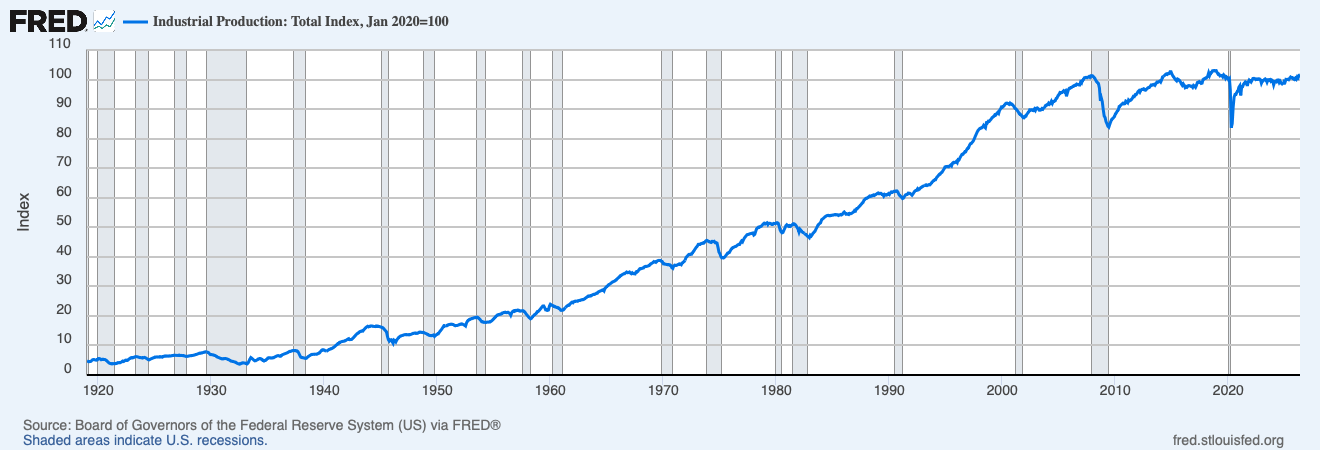
Capacity utilization was 76.2 percent in May, up from 76.1 percent in the prior month. It was 0.3 percentage points higher than its year-earlier level and 3.2 percentage points below its long-run average.