

Weekly Update
March 23, 2026

Upcoming Events
Monday, March 23
GDPNow Update
Tuesday, March 24
Money Stock Measures Release
Wednesday, March 25
Barr Speaks at National Community Investment Conference
Miran Speaks at Digital Asset Summit
Thursday, March 26
Jefferson speaks at Dallas Fed’s Global Perspectives Event
Barr Speaks at Brookings Papers on Economic Activity Dinner
Cook Speaks Yale Program on Financial Stability Event
Miran speaks at the Economic Club of Miami Event
Friday, March 27
Surveys of Consumers Update
Recent News
Holding firm… As expected, the Federal Open Market Committee held its federal funds rate target range at 3.5 to 3.75 percent last week. Its policy rate has remained unchanged since December 2025.
At the post-meeting press conference, Federal Reserve Chair Jerome Powell blamed “a series of shocks,” including tariffs and now the conflict in the Middle East, for the lack of progress on inflation. He said it “is kind of standard learning that you look through energy shocks, but that’s always been dependent on inflation expectations remaining well anchored.”
Gov. Stephen Miran dissented from the decision, preferring to cut rates by 25 basis points.
Gov. Christopher Waller was expected to dissent as well, but didn’t. He explained his decision on CNBC late last week:
Two weeks ago, when the jobs report came out and it was negative 92,000, I thought: That’s it. I’m dissenting. I’m supporting a rate cut. Because, at that time exactly, it looked to me like this was going to be a very short-lived spike in oil, no inflation issues: Look through it. Since that time, the Strait of Hormuz was closed. This is looking like it’s going to be a much more protracted conflict and oil prices are going to stay high for a longer time. So that suggested inflation was more of a concern than I was putting it.
The second piece of information that came out […] was that—we’ve seen a lot of research recently that suggests that, this year, labor force growth is going to be zero—or, close to zero. If that’s the case, you don’t need any—you know, zero is the breakeven for net new jobs […] and then for the last three months it’s averaged right around zero. So, I’m kind of in this—kind of odd spot, where like my brain understands the math but I can’t get through my gut that this is OK.
Looking ahead… FOMC members also submitted new projections for inflation, production, and unemployment.
The median FOMC member now expects the Personal Consumption Expenditures Price Index will grow 2.7 percent in 2026. Back in December 2025, he or she had projected 2.4 percent this year. The median member now projects 2.2 percent PCEPI inflation in 2027 (up from 2.1 percent) and 2.0 percent PCEPI inflation in 2028 (unchanged).
The median FOMC member revised up their projection for real Gross Domestic Product growth. They now expect 2.4 percent real GDP growth in 2026, compared with 2.3 percent projected back in December. The median member now projects 2.3 percent real GDP growth in 2027 (up from 2.0 percent) and 2.1 percent real GDP growth in 2028 (up from 1.9 percent).
The median FOMC member continues to expect 4.4 percent unemployment in 2026, 4.3 percent unemployment in 2027, and 4.2 percent unemployment in 2022.
Production… Industrial production increased 0.2 percent in February 2026, new data from the Fed show. Industrial production was 1.4 percentage points higher than its year-earlier level. It was 1.5 percentage points higher than it was in January 2020, just prior to the pandemic.
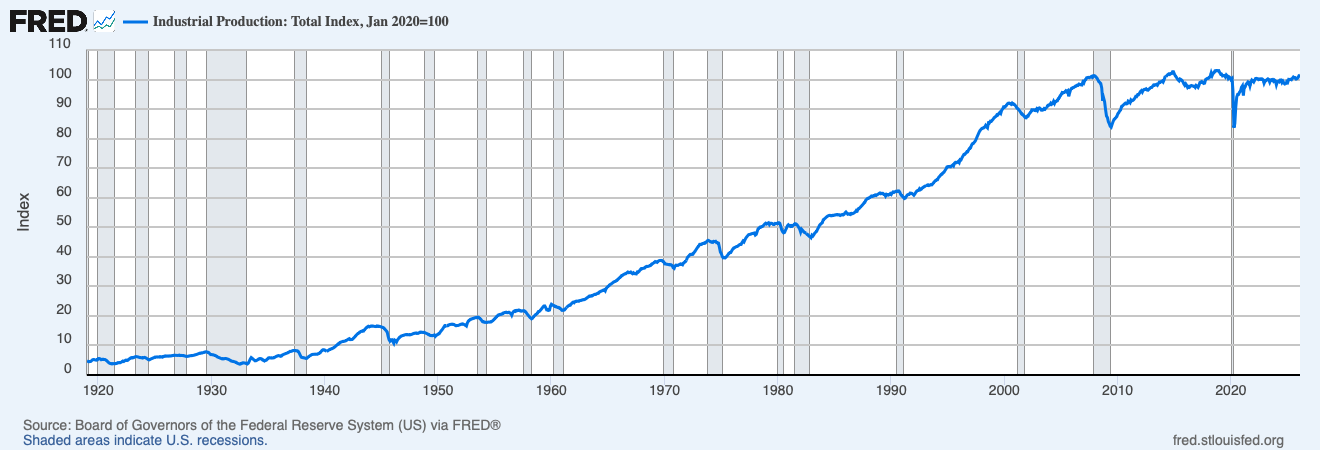
Capacity utilization was 76.3 percent in February, which was unchanged from the prior month. It was on par with its year-earlier level and 3.1 percentage points below its long-run average.