

Weekly Update
February 23, 2026

Upcoming Events
Monday, February 23
GDPNow Update
Waller Speaks at National Association for Business Economics Economic Policy Conference
Tuesday, February 24
Money Stock Measures Release
GDPNow Update
Waller Speaks at Boston/Atlanta/Richmond Fed Conference
Cook Speaks at National Association for Business Economics Economic Policy Conference
Goolsbee Speaks at National Association for Business Economics Economic Policy Conference
Collins Speaks at Boston/Atlanta/Richmond Fed Conference
Barkin Speaks at Boston/Atlanta/Richmond Fed Conference
Friday, February 27
Producer Price Index Release
GDPNow Update
Recent News
Minute details… Some Federal Open Market Committee members appear to be concerned about the recent surge in nominal spending. “Several participants,” the minutes from the January 2026 meeting indicate, thought “sustained demand pressures could keep inflation elevated relative to the Committee's 2 percent objective.”
That view is consistent with the Fed staff’s outlook:
Real GDP growth was expected to outpace potential growth through 2028 as the drag from higher tariffs waned and as fiscal policy and financial market conditions continued to support spending. As a result, the unemployment rate was expected to decline gradually starting this year, moving below the staff’s estimate of its natural rate by the end of the year and remaining below the natural rate through 2028.
[…]
The staff's inflation forecast was slightly higher, on balance, than the one prepared for the December meeting, reflecting the expectation that resource utilization would be tighter and the path of core import prices would be higher than previously projected.
[…]
Risks to the inflation projection continued to be viewed as skewed to the upside: With inflation having remained above 2 percent since early 2021, a salient risk was that inflation would prove to be more persistent than the staff anticipated.
It is not clear from the minutes just how many FOMC members are concerned about the increase in nominal spending growth over the back half of 2025 and the potential for faster nominal spending growth to continue into 2026—nor whether those concerned get to vote at this year’s meetings. But FOMC members will find it harder to cut their federal funds rate target if they worry nominal spending growth has picked back up. Indeed, those concerned may even consider reversing course.
Solid growth… Real gross domestic product (GDP) grew at a continuously compounding annualized rate of 1.4 percent in 2025:Q4, according to the first estimate from the Bureau of Economic Analysis released last week. It has grown 2.2 percent over the last year.
Real GDP dipped in 2025:Q1, as Americans loaded up on imports ahead of the Liberation Day tariff hikes. But it has grown much faster than most FOMC members anticipated in the time since. At the December 2025 meeting, the median FOMC member projected real GDP would grow just 1.7 percent in 2025—50 basis points slower than the BEA now reports.
Production… Industrial production increased 0.7 percent in January 2026, new data from the Fed show. Industrial production was 2.3 percentage points higher than its year-earlier level. It was 1.3 percentage points higher than it was in January 2020, just prior to the pandemic.
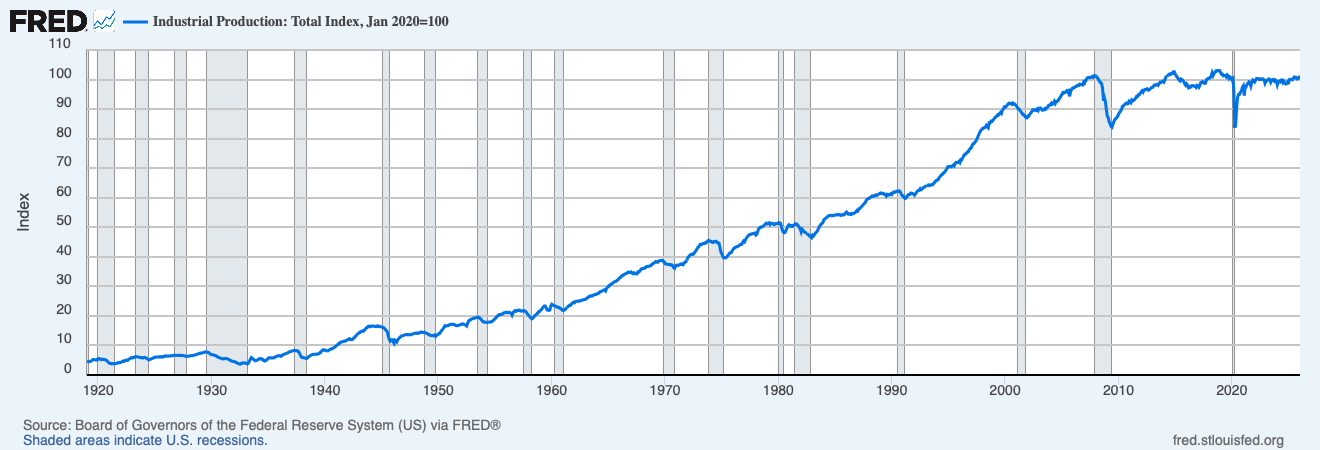
Capacity utilization was 76.2 percent in January, up from 75.7 percent in the prior month. It was 1.4 percentage points above its year-earlier level and 3.2 percentage points below its long-run average.
Prices… Inflation surged in December 2025, delayed data from the BEA show. The Personal Consumption Expenditures Price Index, which is the Fed’s preferred measure of inflation, grew at a continuously compounding annualized rate of 4.3 percent month-over-month. It has grown at an annualized rate of 3.1 percent over the last three months and 2.9 percent over the last year.
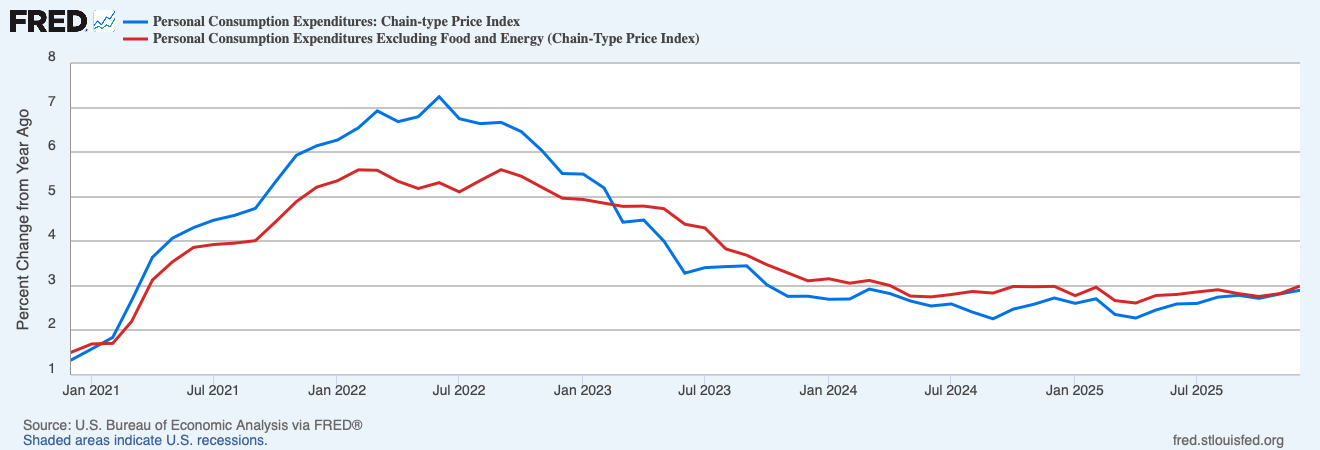
Core PCEPI, which excludes volatile food and energy prices but also puts more weight on housing services, grew at a continuously compounding annualized rate of 4.3 percent in December 2025. It has grown at an annualized rate of 3.0 percent over the last three months and 3.0 percent over the last year.