

Weekly Update
March 9, 2026

Upcoming Events
Monday, March 9
Survey of Consumer Expectations Release
Wednesday, March 11
Consumer Price Index Release
Thursday, March 12
Financial Accounts of the United States Release
GDPNow Update
Friday, March 13
Personal Consumption Expenditures Price Index Release
Job Openings and Labor Turnover Survey
Surveys of Consumers
GDPNow Update
Recent News
Data dependent… Two weeks ago, Federal Reserve Governor Christopher Waller was unconvinced that the labor market had “pivoted to a more solid footing.” But he couldn’t “dismiss the possibility.” Waller said there were “enough asterisks around the January data’’ that he—and presumably other members of the Federal Open Market Committee—would “need to see the February report due March 6 before forming any judgment on whether there has been a rebound in the labor market.”
The February report is now in. And it suggests the January rebound was just a blip.
In an appearance on Kudlow Friday afternoon, Vice Chair for Supervision Michelle Bowman said she “was fine with holding at our January meeting.” But she thinks the latest data reveal “that there is a trend, that is the labor market deteriorating.” Bowman said she believes it will be appropriate to reduce the federal funds rate target by 75 basis points this year.
Employment situation… The economy lost 92,000 jobs in February 2026, according to the latest release from the Bureau of Labor Statistics.
Total nonfarm payroll employment was revised down by 65,000, December 2025, from +48,000 to -17,000. It was revised down by 4,000 for January 2026, from +130,000 to +126,000. After taking all revisions into account, the economy added just 156,000 jobs over the last year—or, roughly 13,000 jobs per month.
The labor force was 170.5 million in February 2026, roughly unchanged from the prior month. The total number of employed persons decreased from 163.1 million to 162.9 million. The total number of unemployed persons increased from 7.4 million to 7.6 million, with the unemployment rate rising from 4.3 percent to 4.4 percent.
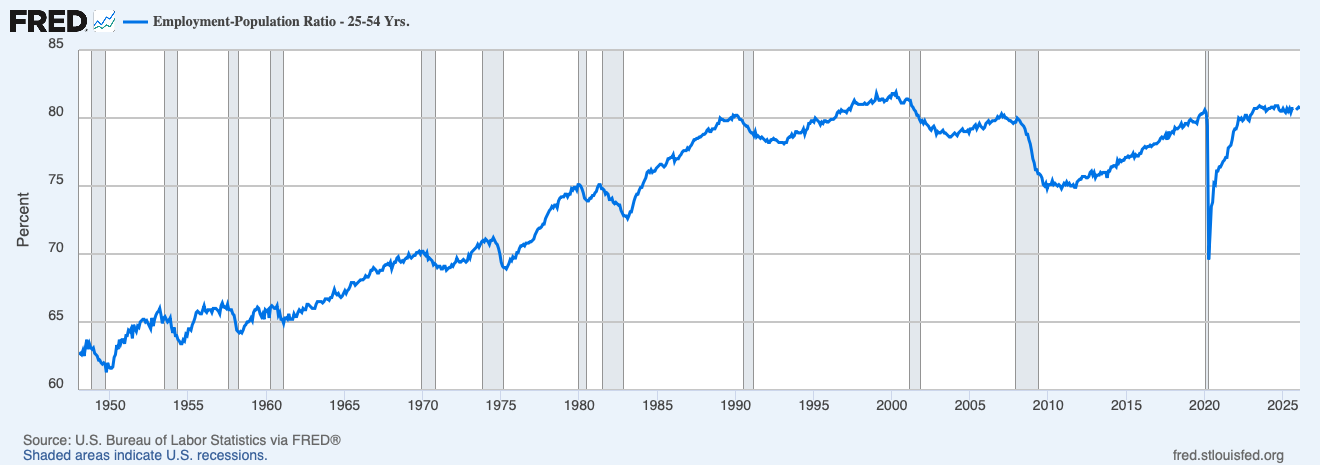
Prime-age employment remains strong. In February 2026, 80.7 percent of those 25 to 54 years old were employed, compared with 80.8 percent in January. For comparison, 80.6 percent of prime-age workers were employed in January 2020, just prior to the pandemic.
Expert opinion… Professional forecasters revised up their projections for economic growth, according to the latest survey from the Philadelphia Fed. They now expect 2.6 percent annualized real GDP growth in 2026:Q1, up from their earlier 1.6 percent projection. They expect real GDP growth will average 2.5 percent in 2026, up from their earlier projection of 1.8 percent.
Professional forecasters also expect higher inflation. Previously, they thought the Personal Consumption Expenditures Price Index (PCEPI) would grow 2.6 percent in 2025. Now, they expect 2.7 percent PCEPI inflation. They think PCEPI inflation will average 2.3 percent in 2027 and 2.2 percent in 2028.