


Upcoming Events
Tuesday, September 1
Construction Spending
ISM Manufacturing Index
Job Openings and Labor Turnover Survey
GDPNow update
Wednesday, September 2
Factory Orders
Beige Book
Thursday, September 3
Initial Jobless Claims
International Trade in Goods and Services
Productivity and Costs (revised)
ISM Services Index
GDPNow update
Governor Waller speaks on the economic outlook
Friday, September 4
Employment Situation
Recent News
Inflation Stalled in July… The Bureau of Economic Analysis reported Wednesday that the personal consumption expenditures price index rose 0.2 percent in July. Core prices, which exclude food and energy, also increased 0.2 percent. Over the twelve months through July, headline PCE inflation was 3.7 percent, while core inflation was 3.3 percent. The chart below places the latest figures in context. Headline inflation bottomed out near 2.2 percent in the middle of last year, then climbed to roughly 4.0 percent this spring before easing. Core inflation, meanwhile, has risen from about 2.7 percent a year ago to 3.3 percent today. Neither measure is moving convincingly toward the Federal Reserve’s 2 percent target.
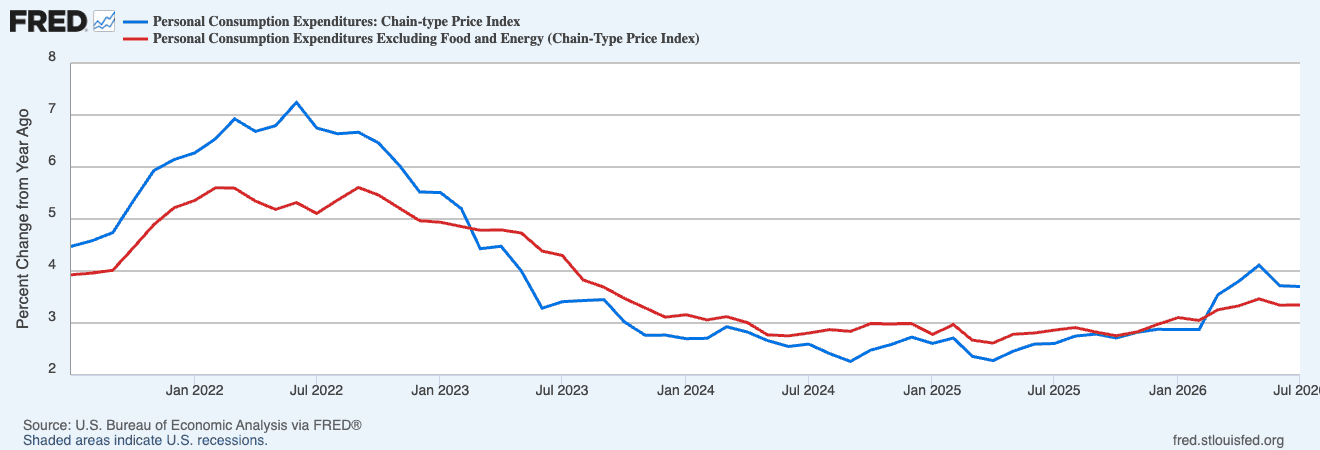
Spending Growth Remains Too Fast… The BEA also released its second estimate of second-quarter GDP on Wednesday. Real output growth was unchanged at an annualized rate of 1.5 percent, while nominal GDP (the total amount spent on domestically produced goods and services) was revised up to 8.0 percent from 7.9 percent in the advance estimate. The revision weakens the case for monetary easing. If productive capacity is expanding by about 2 percent a year, nominal spending must grow at roughly 4 percent to be consistent with 2 percent inflation. It grew at twice that rate last quarter, and the latest revision moved it farther from that benchmark, not closer.
Warsh at Jackson Hole… Chair Kevin Warsh delivered his first keynote address at Jackson Hole on Friday. He discussed artificial intelligence, forward guidance, and the principles he believes should guide monetary policy, but inflation was the central theme.
Warsh characterized the labor market as consistent with full employment and praised the economy’s overall performance. On inflation, however, he was less sanguine. He noted that the PCE price index had risen 3.7 percent over the past twelve months and 4.1 percent at a six-month annualized rate. He was blunt about where responsibility lies:
There is one signal nobody can miss: The responsibility for 65 months of sustained, elevated inflation sits squarely with the central bank. And that is where it belongs.
Warsh also cautioned against interpreting the summer’s softer readings as evidence of meaningful progress. Breaking the PCE price index into its 199 components, he noted that 54 percent had risen by more than 3 percent over the past twelve months, compared with 32 percent, on average, during the two decades before the pandemic.
Warsh sees little evidence that monetary policy is meaningfully restraining economic activity. Pointing to narrow credit spreads, heavy issuance, and accommodative bank lending standards, he said he would be “hard pressed to describe broad financial conditions as restrictive.” He also put money growth back on the list of indicators the Fed should watch:
[M]oney matters. It’s not fashionable these days, but my view is that money has something important to do with monetary policy. We should pay attention to money created by the central bank and money that comes from the banking and financial systems.
Warsh offered no signal about the September meeting: “I stand here today committed to a discipline, not to a decision.” He did, however, set a clear standard for judging the inflation outlook. The Committee must “be confident that underlying inflation is moving to our objective, clearly and at sufficient speed. Otherwise, we have work to do.”
Sound Money Project Roundup
Standing Still as Inflation Runs Hot - Bryan Cutsinger
Warsh Wants the Federal Reserve to Rethink the Rules - Thomas L. Hogan
Fed’s Task Force Should Fix What It Targets - Nicolas Cachanosky
July Inflation Rises, But Weakening Labor Complicates Fed’s Choice - Nicolas Cachanosky
With Energy Prices Falling, Inflation Has Nowhere to Hide - Bryan Cutsinger